What to Wear in Florence if You Don’t Want to Look Like a Tourist
What to Wear in Florence if You Don’t Want to Look Like a Tourist
The tourist uniform in Florence is easy to spot. Comfortable sneakers — the kind that announce they were chosen for cobblestones, not for style. A crossbody bag worn across the front like a shield. Shorts or a linen shirt in a color that says “vacation.” A camera or phone raised at eye level in the middle of a piazza.
None of this is wrong. Florence has cobblestones, and your feet will suffer for bad footwear choices. But there’s a difference between dressing for comfort and dressing in a way that signals you’ve already mentally checked out of the city before you’ve arrived.
Florentines notice. Not with judgment, exactly — more with the mild disinterest of someone who has seen the same thing many times. The city that gave the world the Renaissance, Gucci, and Ferragamo has its own quiet standard of how people present themselves. You don’t have to meet it to have a good trip. But if you want to feel like you belong here, even briefly, it helps to understand what it actually is.
What Florentines are not doing
Before the list of what to wear, it’s worth being specific about what Florentines are not doing.
They are not wearing matching linen sets bought specifically for the trip. They are not in activewear outside of an actual athletic context. They are not in flip-flops unless within immediate reach of water. They are not carrying a tote bag with the name of a city printed on it. They are not dressed as though they are about to hike, even if the city requires significant walking.
The consistent thing about Florentine dress — and this applies to the woman in her 30s heading to work and the woman in her 60s having coffee at a bar — is intentionality. The outfit looks like it was chosen. Not elaborate, not expensive necessarily, but decided. There is a coherence to it: the shoe relates to the trouser, the bag relates to the coat, nothing is an afterthought.
The actual logic
The underlying logic of dressing well in Florence is not complicated, but it is specific.
Structure over comfort signaling. Florentines are comfortable, but they don’t dress in a way that prioritizes announcing comfort. A tailored trouser is as comfortable as sweatpants if it fits correctly. A leather boot with a low heel is as walkable as a sneaker after the first day of breaking it in. The choice between structured and unstructured is not always a choice between comfort and discomfort — it’s often a choice between looking like you thought about it and looking like you didn’t.
Quality reads from across the room. In a city where craftsmanship is embedded in the culture — where leather has been worked by hand for centuries, where tailoring is considered a form of intelligence — poor fabric quality is visible in a way it might not be elsewhere. This doesn’t mean expensive. It means deliberate. One well-made piece does more than five mediocre ones.
Color as restraint, not limitation. Florentine palettes tend toward the serious: navy, black, camel, stone, deep burgundy, olive. This isn’t aesthetic timidity — it’s a form of authority. When everything you’re wearing is in the same register, you stop looking assembled and start looking decided. The occasional strong color works precisely because everything around it is contained.
The shoe is not an afterthought. Italians, and Florentines specifically, read a shoe the way other cultures read a watch. It is one of the first things noticed and one of the things that most clearly signals whether an outfit was thought through. This doesn’t mean heels — it means a boot, a loafer, or a leather flat with enough weight and quality to read as intentional. The white running shoe, however technically comfortable, tends to anchor an outfit in tourist territory regardless of what’s above it.
What actually works
In practical terms, the outfits that read as belonging in Florence share a few qualities.
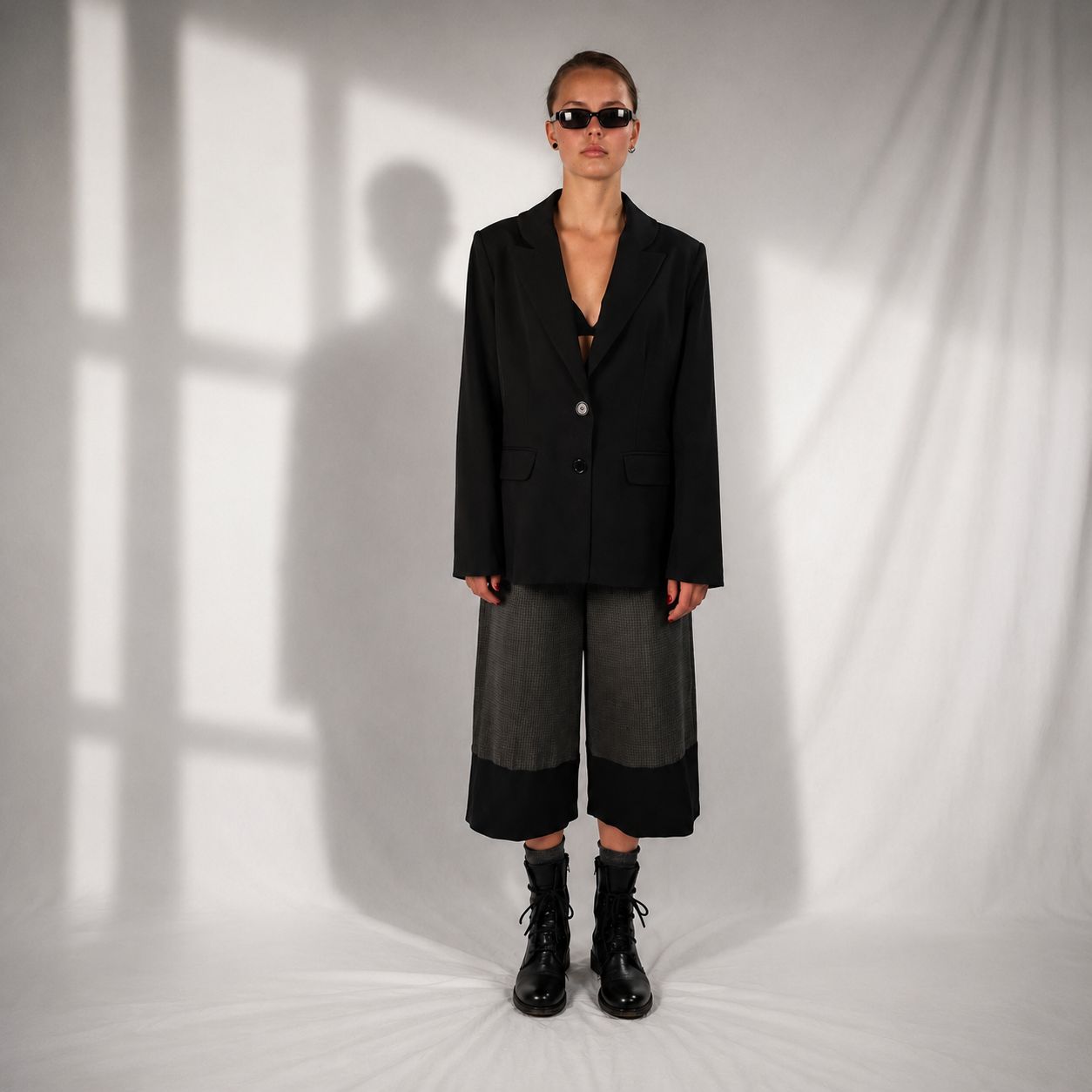
A structured base — trousers or a midi skirt — in a dark or neutral tone. A top that has some presence: a silk blouse, a well-cut shirt, something with a collar. A layer with form: a blazer, a trench, a structured coat rather than a puffer or a hoodie. Shoes with weight. A bag that is closed, structured, and carried with intention rather than function.
None of this requires buying new clothes. It requires thinking about what you already own in these terms, and packing accordingly.
That said, Florence is one of the few cities in the world where buying something to wear is genuinely part of the experience — and not as souvenir.
If you’re going to buy something in Florence, buy something that changes the outfit
The city has no shortage of places to spend money on clothes. Most of them will sell you something you could have bought at home, or something that will look right in Florence for the week and nowhere else afterward.
The more interesting proposition is finding something that actually shifts the logic of what you’re wearing — a piece with a point of view strong enough to carry an outfit rather than just complete one.
That’s a different kind of shopping, and it requires a different kind of place.
Near the Ponte Vecchio, on Via Lambertesca, Monte Sharp is a fashion studio that works on exactly that premise. The clothes are structured, precise, and built around the idea of interrupting a correct silhouette — a shirt with a collar that doesn’t quite land where you expect, a dress with proportion that shifts slightly off-axis. They’re made in Italy, in limited production, with Tuscan artisans and materials recovered from major fashion houses. Nothing is restocked indefinitely.
Which is, as it happens, exactly how Florentines look.
The short version
Dress for where you are, not where you’ve come from. Choose structure over the suggestion of effort. Buy one thing that makes the rest of the trip feel different.
Florence will still be beautiful in your sneakers. But it will feel like yours in something better.
Monte Sharp is located at Via Lambertesca 13 R, Florence — a few steps from Ponte Vecchio.