Best Fashion Experiences in Florence — Beyond the Flagship Stores
The Best Fashion Experiences in Florence (And How to Think About Them)
Florence is not a fashion city the way Milan is a fashion city. Milan is where the industry lives — the shows, the headquarters, the deals, the buyers. Florence is where fashion came from. The history here is not background detail. It is the actual substance of the city.
Italian haute couture was formally introduced to the world in Florence, not Milan, when Giovanni Battista Giorgini organized a landmark fashion show in 1951 that put Made in Italy on the international map for the first time. The city had been producing silk, leather, and textile craft for centuries before that — supplying the courts of Europe, dressing the Medicis, training the artisans whose techniques still run through the best of Italian luxury today.
What that means for a visitor is that fashion in Florence can be experienced at multiple levels simultaneously: as history, as craft, as contemporary design, and as something you can actually wear out of the studio. No other city offers all four in the same afternoon.
Here is how to think about each.
Fashion as history: the museums
Florence has three institutions that handle fashion history at a serious level — not retail nostalgia, but genuine cultural argument.
Museo Salvatore Ferragamo, housed in the medieval Palazzo Spini Feroni on Via de’ Tornabuoni, traces the work of one of the most genuinely innovative designers in fashion history. Ferragamo was not primarily an aesthete — he was a problem-solver. He spent his career solving structural and material challenges that no one else had addressed: how to build a shoe that supported the body correctly, how to work with materials under wartime restriction, how to make something both beautiful and structurally rigorous. The museum presents that work with intelligence. It is worth more time than most visitors give it.
Gucci Garden, inside the historic Palazzo della Mercanzia on Piazza della Signoria, approaches fashion differently — as mythology, imagination, and accumulated cultural argument. A century of creativity from one of Florence’s most significant houses, presented in a space that understands that fashion and art are not always separate things. Whether or not Gucci is your aesthetic, the exhibition is genuinely interesting as a document of how a brand builds meaning over time.
The Museum of Fashion and Costume at Palazzo Pitti is less visited and arguably more significant. Its collection spans from the 18th century to the present, and includes work by Valentino, Versace, Armani, Missoni and Saint Laurent alongside historical costume. The itinerary traces fashion as a document of social history — how skirt length, collar height and fabric weight encoded status, period and intention across three centuries. For anyone interested in fashion as culture rather than as consumption, this is the most serious of the three.
Fashion as event: Pitti Uomo
Twice a year — in January and June — Florence becomes the center of the global menswear industry. Pitti Uomo, held at the Fortezza da Basso, is the world’s most important menswear trade fair, drawing over 730 brands and thousands of buyers, editors and designers from every major fashion capital.
For visitors who happen to be in Florence during these dates, the experience is worth understanding correctly. The fair itself is trade-only, but the city during Pitti week is something else — a real-time document of how people in the industry think about dressing. The streets around the Fortezza, the bars of Via Tornabuoni, the restaurants near Piazza della Signoria become a kind of open-air editorial. It’s the only moment in the year when Florence’s historical relationship with fashion becomes entirely visible in the present tense.
Fashion as craft: the artisan quarter
Florence’s Oltrarno — the neighborhoods of Santo Spirito and San Frediano on the south side of the Arno — still functions as an artisan district in a way that most European cities have lost. Leather workshops, jewellers, textile artisans and small design studios operate in ground-floor spaces that have housed craft for centuries.
This is not a tourist reconstruction. It is working production, and visiting it requires treating it as such — with attention and time, not as a scenic stop between the Uffizi and dinner. The Scuola del Cuoio behind Santa Croce, where leather has been worked by hand since the aftermath of World War II, is the most formally organized entry point. But the more interesting encounters in Oltrarno tend to happen when you walk without a destination and look through the right doors.
Fashion as living studio: the contemporary independent scene
History and craft are easy to find in Florence. The harder thing to find — and the most interesting, for someone who is not here primarily as a tourist — is fashion being made right now, in the city, with a contemporary point of view.
That exists. It is smaller and less visible than the museums, and it requires knowing where to look.
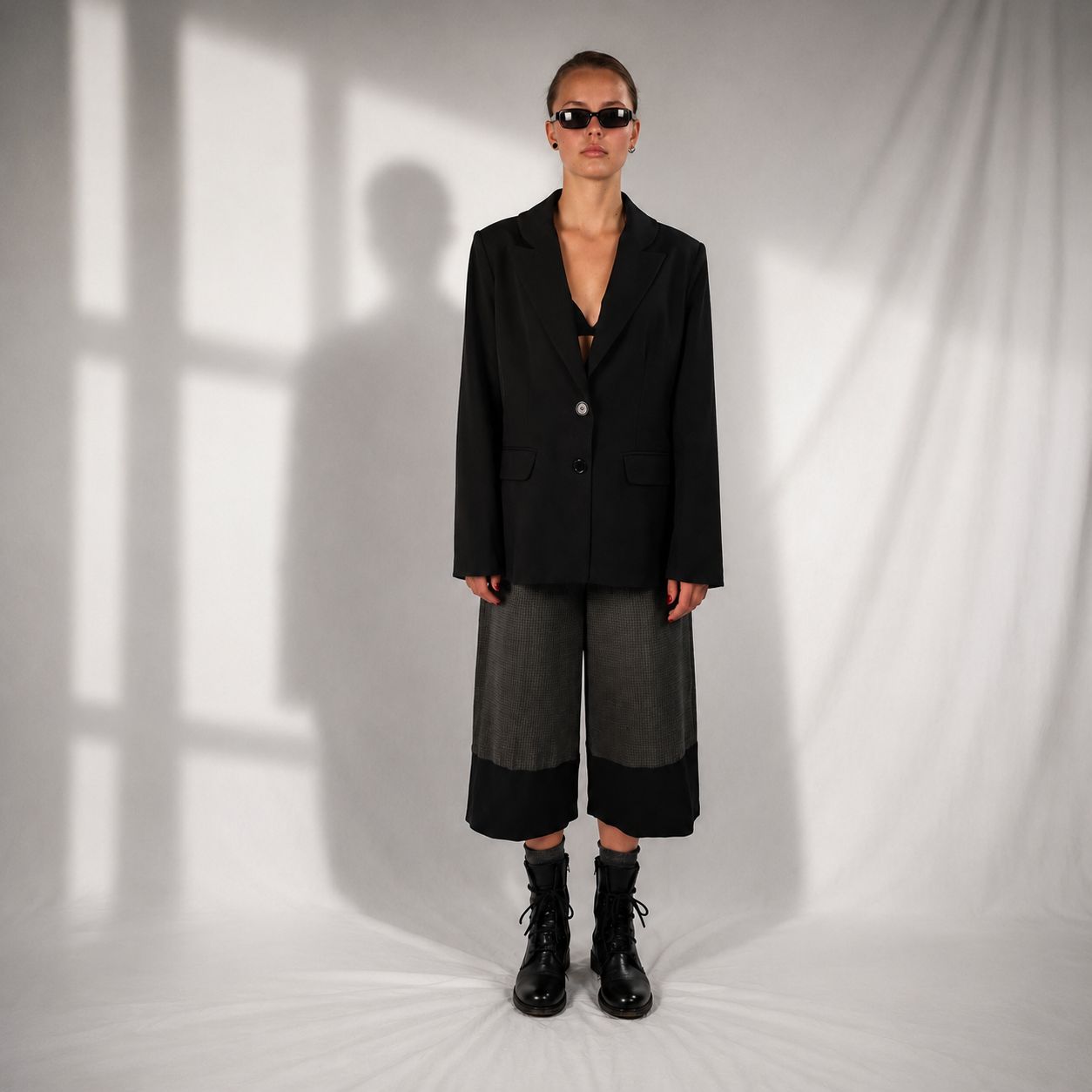
Near the Ponte Vecchio, on Via Lambertesca, Monte Sharp is a fashion studio that operates on a different logic from everything else on this list. Founded in 2022 by architect-designer Alfredo di Mauro and Gianna Soria, it makes structured, precise clothing for women — pieces built around the idea of interrupting a correct silhouette with something deliberate and slightly off-axis. Everything is made in Italy, in collaboration with Tuscan artisans, from deadstock fabrics recovered from major fashion houses. Production is limited and nothing is restocked indefinitely.
The space itself reads as a studio in session rather than a shop open for browsing. The original wooden door of the building serves as the central display surface. The clothes hang as a small, considered edit rather than a full collection. Visitors who have reviewed it consistently describe the same experience: the feeling of arriving somewhere where something specific is happening, and being briefly included in it.
One visitor described it simply: “It feels more like a fashion or design studio than a store.”
That is the point — and it is the experience that completes what the museums and the artisan workshops cannot offer: fashion not as heritage or craft in the abstract, but as a live proposition about what a woman should look like right now.
How to build a fashion day in Florence
For those who want to structure a day around fashion specifically, one route works better than others.
Start at the Museum of Fashion and Costume at Palazzo Pitti when it opens — it is quieter in the morning and the collection rewards attention. Walk from Palazzo Pitti through the Oltrarno toward Ponte Vecchio, using the streets of Santo Spirito and San Frediano to look into workshops along the way. Cross the bridge, turn left on Via Lambertesca, and visit Monte Sharp — the combination of the artisan walk and the studio gives both experiences their proper context. Continue to Gucci Garden on Piazza della Signoria, which is close enough to end the day with a different kind of fashion argument. Save the Ferragamo Museum for a separate afternoon — it deserves more than a rushed hour.
The day reads as a progression: costume and history, then living craft, then contemporary design, then mythology. Florence offers all of it within walking distance. Most visitors see none of it.
Monte Sharp — Via Lambertesca 13 R, Florence. Steps from Ponte Vecchio.