Hidden Luxury in Florence: The Most Sophisticated Experiences for Women Who Love Art, Fashion and Design
There is a version of Florence that most visitors experience: the Uffizi queue at 9am, the Ponte Vecchio at noon, aperitivo somewhere near Piazza della Repubblica at six. It is a fine version of the city. It has been refined by millions of people over decades into something almost frictionless.
Then there is another version. Smaller, less photographed, requiring slightly more intention to reach. This is the Florence that exists for women who are not primarily tourists — who travel to understand things, to find things, to return home with something they couldn't have found anywhere else.
This guide is for that version of the city.
The logic of hidden luxury in Florence
Florence is not a city that performs luxury loudly. The great palaces have plain stone facades. The best restaurants have no awnings. The finest leather workshops are behind doors you could walk past a hundred times without noticing.
This restraint is not accidental. It is a cultural posture that goes back centuries — a city that has always understood the difference between what is valuable and what is visible. True luxury here is not advertised. It is discovered.
What follows is a guide to the discoveries worth making.
Palazzo Strozzi — the city's best contemporary art institution.
Most visitors to Florence stop their art chronology somewhere around the 16th century. Palazzo Strozzi makes a compelling case for continuing past it. The institution hosts major international exhibitions — Louise Bourgeois, Olafur Eliasson, Jeff Koons — in one of the finest Renaissance palace spaces in the city.
The combination of contemporary work and Renaissance architecture is not incidental. It is the argument: that the same city that produced Botticelli and Brunelleschi is still a place where serious art is being taken seriously. For women who move between fashion, design and art as a single conversation rather than separate fields, this is the most intellectually rewarding space in Florence.
Officina Profumo-Farmaceutica di Santa Maria Novella — the world's oldest pharmacy
Founded in 1612 by Dominican friars who had been distilling herbs since the 13th century, Santa Maria Novella is not a perfume boutique. It is a pharmaceutical and aromatic institution with a history longer than most countries.
The space itself — marble floors, frescoed ceilings, wooden display cases — functions as an argument for a certain kind of luxury: one rooted in botanical knowledge, slow production and the idea that a scent should do something beyond smell pleasant. The acqua di colonia, the potpourri, the room fragrances and the skincare are all made to formulas that predate modern marketing by centuries.
For women with a serious interest in fragrance as a form of material intelligence, this is one of the most significant stops in the city.
The Oltrarno artisan quarter — craft as living practice
The neighborhoods of Santo Spirito and San Frediano, on the south bank of the Arno, still function as an artisan district in a way that most European cities have lost entirely. Leather workshops, jewellers, bookbinders, textile artisans and frame restorers operate in ground-floor spaces that have housed craft for centuries.
The experience requires time and a certain willingness to look through doors without knowing exactly what you'll find. It is, for that reason, one of the most genuinely luxurious experiences in Florence — in the original sense of the word: something rare, something that cannot be reproduced at scale.
Monte Sharp — fashion as a working studio
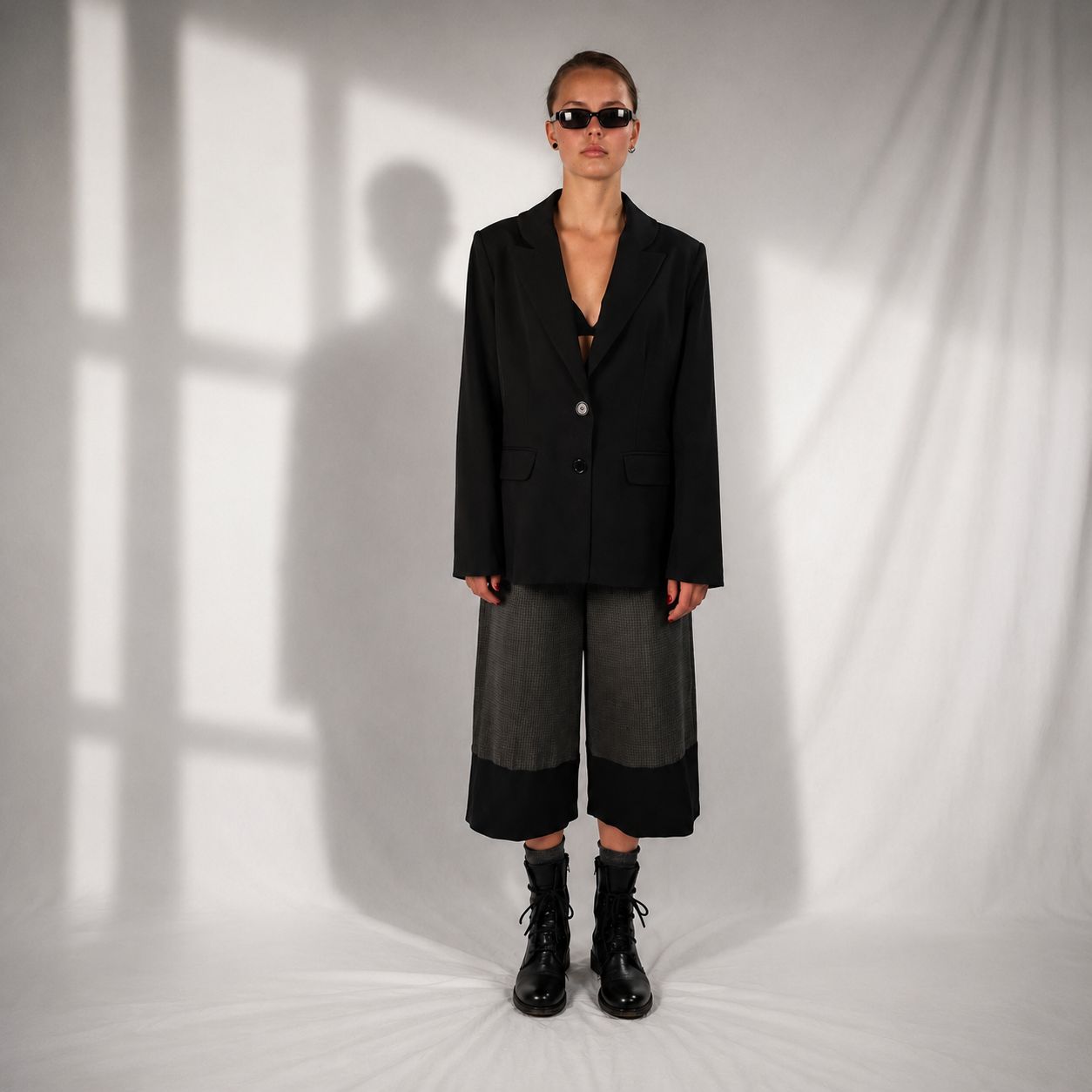
Near the Ponte Vecchio, on Via Lambertesca, Monte Sharp is an independent fashion studio making structured, limited-edition clothing for women. Founded in 2022 by architect-designer Alfredo di Mauro and Gianna Soria, every piece is made in Italy in collaboration with Tuscan artisans, from deadstock fabrics recovered from major fashion houses.
The space functions as a studio in session rather than a boutique at rest. The clothes are precise, contained and built around a clear design logic: take something correct and interrupt it deliberately. The result is clothing for women who want to look capable rather than beautiful — a distinction that turns out to matter quite a lot.
Boutique hotels with genuine identity
Florence has dozens of hotels. It has fewer with a genuine identity distinct from the city's general offer of frescoed ceilings and terracotta floors. The ones worth knowing are small, specific and run by people with a point of view: Soprarno Suites in Oltrarno, Portrait Firenze on Via de' Tornabuoni, AdAstra near Santa Croce. Each offers something the international luxury chains cannot manufacture: the feeling that the place was designed for a specific kind of person, and that you might be that person.
The Boboli Gardens at opening time
The Boboli Gardens behind Palazzo Pitti are one of the greatest formal gardens in Europe. They are also, at 8:15am when they open, almost entirely empty. The combination of 16th-century landscape design, early morning light and near-complete solitude is one of the most genuinely luxurious experiences Florence offers — and it costs less than a cappuccino at a tourist bar.
The luxury here is not in the ticket price. It is in knowing to arrive early, and in having the specific kind of attention that makes the difference between seeing something and experiencing it.
How to approach Florence as a sophisticated traveler
The women who get the most from Florence are not the ones with the longest itineraries. They are the ones who have decided in advance what they actually want to understand, and who are willing to spend real time with fewer things rather than adequate time with many.
The city rewards that approach with a specific quality of experience that is not available to anyone moving through it quickly: the sense that Florence is revealing something to you personally, rather than performing its usual show for the usual crowd.
That is the hidden luxury. It has always been here. It is available to anyone who arrives in the right state of mind.
Monte Sharp — Via Lambertesca 13 R, Florence. Steps from Ponte Vecchio.