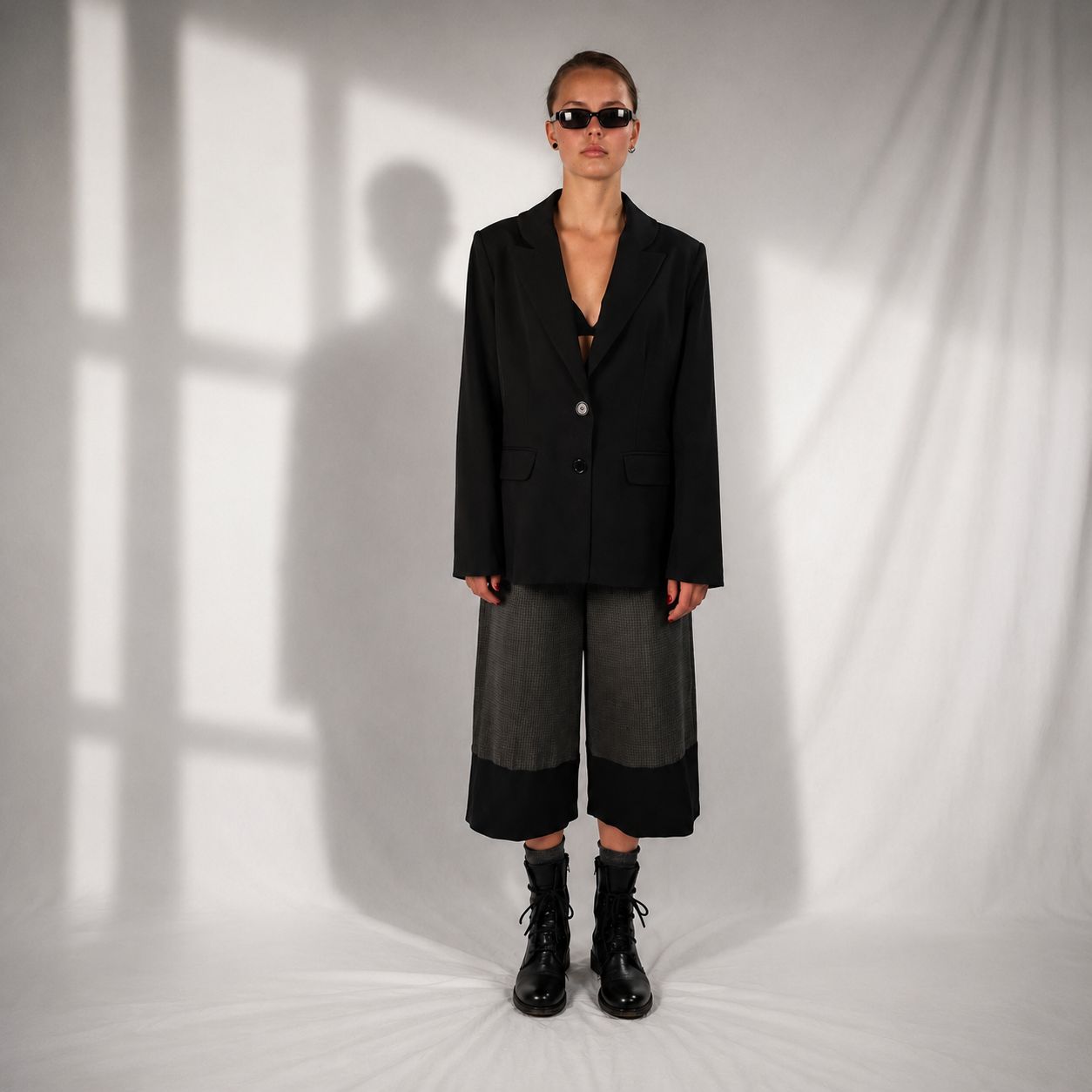
Why Every Monte Sharp Piece Is One of a Kind — The Studio Archive
The Fabric Has Already Lived Inside One of the World’s Great Fashion Houses. Monte ‘0 Is What Happens Next.
Every major fashion house in the world produces more fabric than it uses.
This is not a failure of planning. It is the nature of how luxury is made. A house like Fendi orders a specific wool blend for a specific season. The weavers produce it to specification — a quantity large enough to cover the collection with margin for error, for samples, for fittings, for last-minute changes. What remains after the collection is complete is fabric of the same quality, the same provenance, the same certification as the pieces that appeared on the runway. It simply has no place in the next season’s story.
That fabric exists. It has a name — deadstock. And it is, in a precise sense, the most honest material in the fashion industry: it has already proven what it is and where it belongs.
Monte Sharp is built on what happens to it next.
What the archive contains
The Monte Sharp studio archive is not a collection of remnants. It is a curated inventory of exceptional textiles sourced directly from the surplus of houses that define the upper register of global fashion.
The wool used in current pieces comes from Fendi’s production archive. The denim from Tom Ford. Certain black textiles from Saint Laurent. Other fabrics from houses whose names carry the same weight — sourced season by season, evaluated for quality and quantity, acquired only when the material is genuinely worthy of being redesigned.
This is not a sustainability positioning. Monte Sharp does not make clothing from deadstock because it is the ethical choice — though it is. It makes clothing from deadstock because these are the finest textiles available, because they come with a history that most fabrics never acquire, and because working within the constraint of what exists produces design decisions that purely available-to-order fabric never forces.
The limitation is real. When the fabric is gone, the piece is gone. There is no reorder. There is no second production run. Every Monte Sharp piece is, by definition, the last of its kind.
What the design does
The textiles arrive at the studio with their own authority. A Fendi wool has a weight, a drape, a surface quality that is immediately legible to anyone who handles fabric seriously. The design process at Monte Sharp begins from that authority — not by subordinating it, but by interrupting it.
The design logic of the studio, developed by founder and architect Alfredo di Mauro, applies a single precise principle to each piece: take something correct and introduce one deliberate structural deviation. A shirt made from Saint Laurent black crepe that is almost classical, and then isn’t. A skirt cut from Tom Ford denim with a proportion that reads straightforward until you notice where the seam falls. A coat in Fendi wool with a silhouette that carries the weight of the material and then redirects it slightly off-axis.
The result is clothing that reads as designed rather than assembled. The fabric brings the history. The cut brings the argument.
How a piece is made
Monte Sharp does not maintain a warehouse. It does not produce in anticipation of demand. Every piece begins when an order is placed — which is why the studio uses the term Studio Order rather than pre-order.
The distinction matters. Pre-order implies waiting for something that exists but hasn’t arrived yet. Studio Order means the piece does not exist until you enter the process. Your size is reserved. The fabric from the archive is allocated. The piece is cut and produced by Tuscan artisans in collaboration with the studio, specifically for you, in a production time of two to four weeks.
This is not a logistical constraint presented as a feature. It is the actual nature of how the work is made. The piece that arrives has never existed before. It will not exist again in the same form. The fabric that went into it is no longer available for anything else.
That is what Studio Order means.
The Archive Request
Some pieces in the Monte Sharp catalog are made from fabrics that have been entirely consumed by previous production. The original textile no longer exists in the studio archive.
For these pieces, Monte Sharp offers what it calls an Archive Request. A client who wants a specific design — the cappotto 11R, for example, which has carried a waiting list since its first production — can request it using a fabric from the current studio archive. The design remains. The material changes. The piece produced is different from every previous version and every future version, because the archive it draws from changes with each season.
This is not a compromise. It is the most accurate expression of what Monte Sharp actually is: a studio that works with what exists, produces what is possible, and makes nothing that can be exactly repeated.
What this means when you enter the studio
Via Lambertesca 13R is two minutes from the Ponte Vecchio. The space is small and considered. The fabrics in the room have been inside the production archives of some of the most significant fashion houses in the world.
When you handle a piece at Monte Sharp, you are handling the output of two decisions: the decision of a major house about what quality of material to use for its own work, and the decision of this studio about what to do with what remained. The piece exists because both decisions were made correctly.
Nothing here is mass produced. Everything begins in the studio.
That is not a marketing line. It is a description of the process.
Monte Sharp — Via Lambertesca 11R, Florence. Studio Orders open. Archive Requests by inquiry.