Florence for Women Who Love Architecture, Art and Fashion
There is a type of woman for whom architecture, art and fashion are not separate categories. They are different expressions of the same impulse: the decision to make things that do more than function, that communicate something about how the world could be organized, that reward the attention of people who are paying it.
Florence is one of the few cities in the world where all three disciplines are present simultaneously at the highest level — and where they have been in genuine conversation for centuries. This guide is for women who want to experience that conversation directly.
The architecture first
Florence is a city of architectural arguments. Brunelleschi's dome, Alberti's facade on Santa Maria Novella, Michelozzo's Palazzo Medici Riccardi, Vasari's Uffizi corridor — each of these is not just a building but a proposal about what a building should do, how it should relate to its context, what it should say about the people who commissioned it.
For a woman with an architectural eye, the most instructive walk in Florence is not a museum itinerary. It is a walk without a destination — through the Oltrarno, past Santa Croce, along the streets between Piazza della Signoria and the river — paying attention to facades, proportions, the relationship between buildings and street level, the way the city manages the transition from private to public space.
Florence does this better than almost any other European city. The lessons are available to anyone who arrives with enough attention to receive them.
The art as conversation with the architecture
The great art of Florence cannot be fully understood outside its original context. The Botticellis in the Uffizi were not made for a museum. The Michelangelo in the Accademia was not made for a white room. Understanding what they were made for — and how the architecture of their original settings shaped the experience of encountering them — is the difference between seeing them and understanding them.
Palazzo Strozzi offers the most contemporary version of this conversation: major international artists working in a space with enough authority to challenge them. The building is not a neutral container. It is an active participant in the meaning of what's inside it.
For a woman who understands art as a spatial practice — who thinks about how work exists in a room — this is the most productive contemporary art experience in the city.
Fashion as the third discipline
Fashion, at its most serious, is also a spatial practice. It makes decisions about how a body occupies space — how much volume, where the weight falls, what the silhouette communicates at a distance before anything can be read up close.
The Museum of Fashion and Costume at Palazzo Pitti makes this argument through historical objects. The collection — spanning from 18th-century court dress to 20th-century couture — shows how decisions about construction, proportion and material encode information about power, intention and context in exactly the way that architecture does.
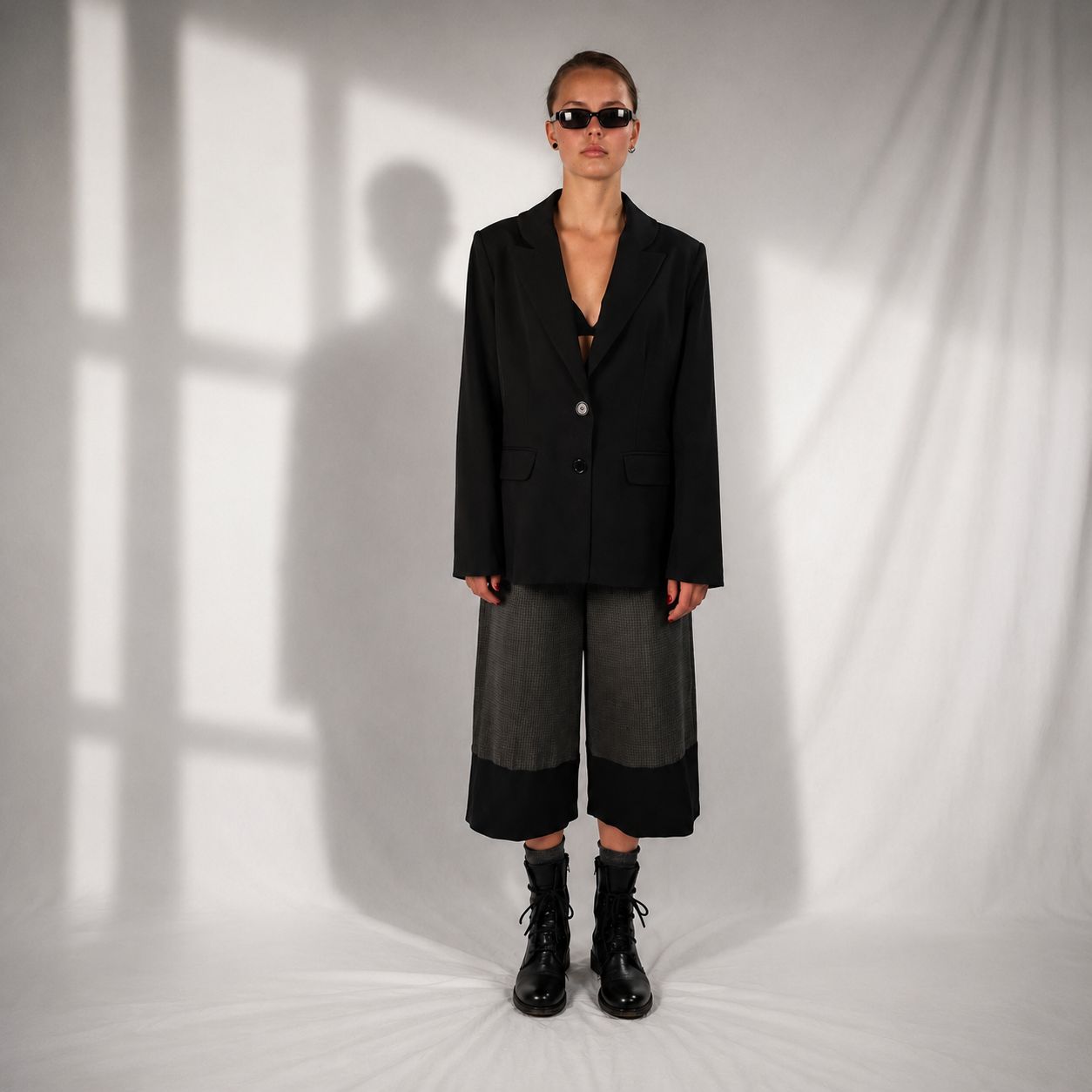
The more immediate version of this argument is available at Monte Sharp.
Monte Sharp — where architecture becomes clothing
Monte Sharp was founded by an architect. That is not incidental. The design logic of the studio — take a correct form, introduce one precise structural intervention, change the reading entirely — is directly derived from architectural thinking.
The clothing is not inspired by architecture in the decorative sense. It does not have ziggurat collars or geodesic seams. It applies architectural principles to the problem of what a woman should look like: how do you build a silhouette that has the same authority as a well-designed building? How do you make something that reads as considered from across a room?
For a woman who moves between architecture and fashion as a single discipline, the studio on Via Lambertesca is the most coherent address in Florence. The clothes are what happens when someone trained to think about structure applies that training to the problem of the body in space.
The Oltrarno as the living version
Architecture, art and fashion all exist, in Florence, in their historical forms. What the Oltrarno offers is their living equivalents: people making things now, by hand, in spaces that have housed making for centuries.
The experience of walking through Santo Spirito and San Frediano — looking into workshops, watching leather being cut, understanding how a thing is assembled from its components — is the most direct access to the design intelligence that produced the city's canonical works. It is available to anyone who walks slowly enough.
How to structure a day around this
Start at Palazzo Strozzi in the morning. Walk through the historic center toward the Uffizi — not necessarily to enter, but to understand the Vasari corridor as an architectural object. Cross to the Oltrarno via the Ponte Vecchio, turning left on Via Lambertesca to visit Monte Sharp. Continue through Santo Spirito and San Frediano toward Palazzo Pitti and the Museum of Fashion and Costume.
The day traces a single argument: how Florence has been making decisions about form — in stone, in paint, in fabric — for six centuries, and what those decisions look like when you encounter them together in a single afternoon.
Monte Sharp — Via Lambertesca 13 R, Florence. Steps from Ponte Vecchio.