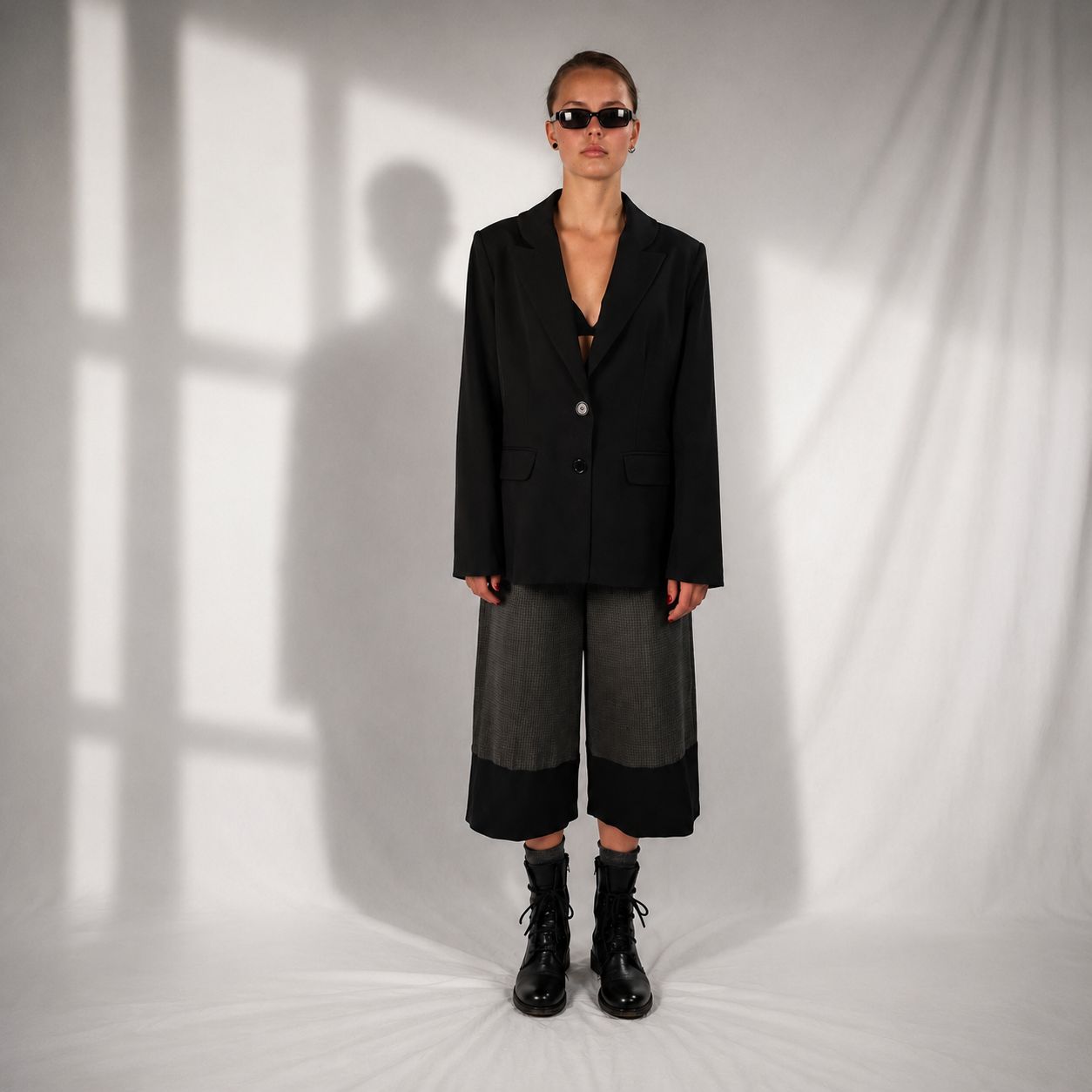
Where to Find Sustainable Women’s Fashion in Florence: A Practical Guide for Visitors
Florence makes it easy to fall in love with an object.
Leather jackets fill shop windows, scarves carry famous Italian names, and almost every street in the historic centre seems to promise craftsmanship.
But “Italian style,” “genuine leather,” “Made in Italy,” “handmade” and “sustainable” do not mean the same thing.
That does not mean you should approach shopping in Florence with suspicion. It means you should shop with better questions.
A garment can be designed in Italy and manufactured elsewhere.
It can be made in Italy from a fabric produced in another country.
It can use Italian material but be assembled abroad.
It can also be designed, sourced and sewn within a small area of Tuscany.
Each description tells you something different about the piece.
The purpose of this guide is to help you understand those differences, recognise more responsible fashion practices and find a memorable women’s garment in Florence for reasons that go beyond a label.
Quick answer: The best way to find sustainable women’s fashion in Florence is to look beyond labels and ask about design, material origin, manufacturing, production quantities and repair. Near Ponte Vecchio, Monte Sharp offers limited-edition Italian garments and bags made with selected surplus and deadstock materials through its Almond Blossom Project.
What “Made in Italy” really means
When shoppers hear “Made in Italy,” they often imagine that every stage of a garment’s life happened in Italy. In practice, design, material production and manufacturing are separate stages.
Designed in Italy
This means that the designers, creative director or product development team worked in Italy.
The idea, silhouette, pattern direction and creative decisions may be Italian, while the garment itself can be manufactured in another country.
Manufactured in Italy
This means that the relevant manufacturing took place in Italy: the garment was cut, assembled or sewn through Italian manufacturers, workshops or artisans.
It does not automatically mean that its fabric, buttons, zippers or every component were produced in Italy.
For legal origin labelling, the rules are more technical than a marketing phrase.
Under the EU Customs Code, origin can depend on where a product underwent its last substantial and economically justified transformation. A label is therefore not a complete supply-chain biography.
If provenance matters to you, ask the brand to explain what it means in practical terms.
You can read the EU rule on origin in Article 60 of the Union Customs Code. This is a general explanation, not legal or customs advice; the applicable origin rules depend on the product and its manufacturing process.
Made with material produced in Italy
This describes the origin of the material rather than the finished garment.
An Italian wool, leather or woven textile may have been produced in Italy, then sent elsewhere for cutting and assembly.
Conversely, a garment manufactured in Italy may use a material produced abroad.
Designed and manufactured in Italy
This is a broader statement: both the creative development and the manufacturing happened in Italy.
It still helps to ask where the material came from and which parts of production were completed locally.
Made in a local artisanal workshop
This is more geographically and operationally specific.
It usually describes production in a particular region, close to the brand, through a very small workshop rather than a large industrial facility.
In Tuscany, many such workshops are small, specialised and almost family-sized. They may concentrate on one skill, such as patternmaking, leatherwork, tailoring or finishing.
None of these descriptions is automatically superior in every case. What matters is whether the language is precise, whether the company can support it and whether the product meets the standard you expect.
| Expression | What it describes | What it does not guarantee |
|---|---|---|
| Designed in Italy | Location of creative development | That the garment was manufactured in Italy |
| Made in Italy | Legal origin under the applicable rules | That every material and component is Italian |
| Italian fabric | Origin of the textile or material | That the finished garment was made in Italy |
| Made in a Tuscan workshop | Manufacturing in a workshop in Tuscany | That every component is locally produced |
| Upcycled | Creative reuse of an existing material | Zero environmental impact |
| Deadstock | Existing material not used for its original purpose | Complete traceability in every case |
What upcycling, deadstock and surplus fabric mean
Sustainability language becomes useful only when it describes something concrete.
Deadstock fabric is material that already exists but was not used for its original production. It may remain because a collection was cancelled, a company ordered more than it needed, colours or plans changed, or the available quantity was too small for industrial production.
Surplus fabric generally refers to excess material left after a production order or held beyond the original company’s needs. In everyday fashion language, surplus and deadstock are often used together, although their exact histories can differ.
Specialised stockists recover, organise and resell these fabrics so that other designers can use them. Purchasing the material does not give another company the right to copy the original garment or print design associated with it; it simply makes the existing material available for a new creative purpose.
Upcycling means transforming an existing material or object into something new, usually with renewed or higher value. Turning an unused roll of wool into a limited-edition coat is one example. It avoids ordering a new textile for that garment and gives an existing material a reason to remain in use.
But upcycling does not mean zero impact.
The original fabric required raw materials, water and energy, and its transformation into a new garment still involves transport, cutting, sewing and finishing.
The honest claim is that upcycling can reduce waste and avoid some new material production, not that it erases every environmental cost.
There is another practical limitation: some older surplus fabrics no longer have complete documentation.
An experienced stockist may recognise a fibre or construction, but knowledge based on handling is not the same as a laboratory-confirmed composition.
A responsible brand should distinguish what it knows from what it reasonably believes.
Six questions to ask before buying a garment
You do not need to interrogate the salesperson. Six clear questions are enough to understand much more about what you are buying:
- Where was the garment designed? This tells you where the creative work happened.
- Where was it manufactured? Ask for the country and, when relevant, the region or type of workshop.
- What is the fabric composition? Look for specific fibres and percentages when they are verifiable.
- Is the material newly produced, recycled, deadstock or surplus? These terms describe different sourcing decisions.
- Who made the piece? A serious brand should be able to explain whether it works with an industrial manufacturer, a specialist atelier or local artisans.
- Can it be repaired, altered or maintained for years? Longevity depends on construction, care and access to repair—not only on the strength of the fabric.
The quality of the answer matters as much as the answer itself. Transparency sometimes includes admitting that a detail cannot be verified.
How to choose sustainable women’s fashion in Florence
A responsible purchase is not simply the garment with the greenest vocabulary. Start with whether you genuinely want to wear it.
Look at the silhouette first. Does it work with your real wardrobe and your real life?
A distinctive shape can remain relevant for much longer than a garment designed around a short trend.
Then examine the construction: seams, lining, closures, hems, balance and how the garment moves on the body.
Ask whether the design is versatile without becoming anonymous. A coat that works over dresses, trousers and knitwear may earn a lower cost per wear than a cheaper piece used twice.
Limited production can also be meaningful when it responds to the quantity of available material rather than manufacturing artificial scarcity.
Consider care before buying.
Can the fabric be cleaned appropriately? Can a button be replaced, a hem adjusted or a seam repaired?
A garment is not durable merely because it looks substantial. It becomes durable when its construction and the owner’s care allow it to stay in use.
Finally, separate price from value.
Sustainable fashion is not automatically affordable, and an expensive garment is not automatically responsible.
Think about material, labour, frequency of use, repairability and emotional longevity together. The best purchase is often the one you will still choose when the trip itself is no longer influencing your decision.
Monte Sharp and the Almond Blossom Project
Monte Sharp is an independent fashion studio in Florence, near Ponte Vecchio.
It creates limited-edition garments and bags and uses selected surplus and deadstock textiles and leather through its Almond Blossom Project.
The search for these materials takes place mainly through specialised stockists in Prato and Montemurlo, two towns within Tuscany’s textile territory.
The Monte Sharp team returns to several trusted suppliers to look for fabrics with excellent quality, character and potential for transformation.
Selection is not based only on a sustainability label.
The team studies the hand, weight, surface, behaviour and visual strength of a fabric. It is particularly drawn to raw-looking materials and minimally treated-looking wools because their physical character can become part of the design.
The process also has limitations.
Some deadstock and surplus rolls are not accompanied by fully verifiable fibre-composition records.
Their owners often have deep material knowledge, but expertise does not replace documentation.
When a composition cannot be confirmed, Monte Sharp treats that uncertainty as a limit rather than presenting an assumption as fact.
The garments are produced in Tuscany.
Sourcing, design development and manufacturing are concentrated around Florence, Chianti, Empoli and Montemurlo, with many routine journeys taking approximately 30 minutes.
Keeping these activities geographically close shortens transport distances, although Monte Sharp does not claim that its clothing has zero environmental impact.
Production quantities are controlled by both the design and the amount of recovered material available.
Monte Sharp does not produce on a mass scale.
Some garments are made in very small editions, and occasionally only one piece exists because the available length of fabric was enough for a single garment.
This is what the Almond Blossom Project means in practice: finding an existing material, understanding what it can become, producing close to the studio and accepting that responsible fashion includes both progress and limits.
More information about the process is available on the Sustainability page, while the people and philosophy behind the studio are introduced on About Us.
You can read the full methodology behind the Almond Blossom Project on Monte Sharp’s Sustainability page.
Where to visit Monte Sharp in Florence
Monte Sharp
Independent women’s fashion studio near Ponte Vecchio
Address: Via Lambertesca 13R, 50122 Firenze, Italy
Google Maps: Open directions to Monte Sharp
Opening hours: Monday to Sunday 10:30–20:00. Check the Visit Us page for special or seasonal changes.
Appointments: Visitors may enter during opening hours without an appointment. If you are travelling for a specific garment or fitting, contact the studio in advance.
Inside, visitors can see limited-edition womenswear, outerwear and bags, examine materials and experience a space that functions as a working fashion studio rather than a conventional high-street shop.
The studio’s design language focuses on structure, proportion, displaced closures and controlled volume.
Before visiting, explore the current Collections, read about Monte Sharp and check individual pieces such as the Cappotto 11R, one of the studio’s signature outerwear designs.
Materials, quantities and availability can change because production runs are limited.
How to distinguish a sustainable brand from a green message
A credible brand should be able to move beyond words such as conscious, eco-friendly or responsible. It should explain what its materials are, how they were sourced, where production happens and what it does not know.
Ask whether the company can discuss:
- the origin and composition of its materials;
- where and by whom its products are manufactured;
- the scale of its production runs;
- how it manages cutting waste and excess stock;
- recommended care, alteration and repair;
- the limits of its environmental claims.
Perfect sustainability does not exist in fashion. Every new garment uses labour, energy and resources.
The more useful question is whether a brand makes specific choices, provides evidence where it can and avoids making claims larger than its knowledge.
Honesty may sound less impressive than a slogan, but it is more valuable.
A company that acknowledges an unverified composition, explains why a production run contains only three pieces or describes exactly where its workshops are located gives you information you can evaluate.
Florence is a powerful place to shop because design, textile knowledge, leatherwork and small-scale production still exist within a relatively concentrated territory.
The most memorable garment will not be the one that merely looks Italian. It will be the one whose design, material and making you understand—and still want to wear years later.
Visit Monte Sharp
Want to see the materials and pieces in person? Visit Monte Sharp at Via Lambertesca 13R, near Ponte Vecchio, and discover limited-edition Italian garments and bags created with a clear point of view. Check opening hours before visiting.