Florence is full of things that look Italian. The more difficult question is: how much of what you see was actually designed, made or transformed here?
If you want to return home with one memorable Italian piece, look beyond the abundance of merchandise. Look for traceability (where it was made and by whom), material honesty (what it’s really made of), and longevity (whether it will still feel right long after the trip).
Quick answer (at a glance)
- Leather jacket (Santa Croce / historic centre): inspect the leather and construction; ask directly about origin and tannery.
- Leather bag (Santa Croce): choose a workshop or brand with a traceable history—not just market volume.
- Silk scarf (city centre): buy for design, silk quality and finishing—not for the logo alone.
- Independent women’s fashion + outerwear (Ponte Vecchio / Via Lambertesca): look for limited editions, strong design language and material transparency.
- Handmade men’s shoes (San Niccolò / Oltrarno): ask about construction, resoling and aftercare.
- Gold jewellery (Ponte Vecchio area / Via Lambertesca): verify hallmark, gold purity and repairability.
1. A genuine leather jacket (Santa Croce + historic centre)
Florence is a natural place to buy a leather jacket because it sits close to Santa Croce sull’Arno, one of Tuscany’s most important leather districts, with a long-established network of tanneries and leather manufacturers. (Santa Croce Leather District)
However, proximity to the leather district does not mean that every jacket sold in Florence is locally made or high quality. The words vera pelle (“genuine leather”) only describe the material. They do not guarantee excellent leather, good construction or Italian production.
Before buying, examine the leather with your hands. It should feel supple rather than coated in plastic. Look at the seams, the lining, the zippers and the finishing around the pockets. Ask directly:
- Where was the jacket made?
- Is the leather Italian?
- What type of leather is it?
- Can the store explain who produces it?
For a contemporary interpretation of a Florentine leather jacket, you can visit Benheart (historic centre). (Benheart)
A good leather jacket should not feel like a costume from your holiday. It should be something you will still want to wear ten years after leaving Florence.
2. A leather bag (but not necessarily from a street market) (Santa Croce)
Florence’s leather markets are visually irresistible. There are bags everywhere, usually surrounded by belts, wallets and jackets in dozens of colours. But quantity is precisely the reason to be cautious.
A stall or shop containing hundreds of almost identical bags is unlikely to represent the work of one Florentine artisan. Some products may be Italian, while others may be imported or industrially manufactured. Location alone is not evidence of provenance.
Instead, look for a company with a traceable history and a recognisable design language.
Scuola del Cuoio, located behind the Basilica of Santa Croce, was created after the Second World War to preserve and teach Florentine leather craftsmanship. It remains both a workshop and a place where visitors can see a more direct connection between the material, the artisan and the finished object. Some pieces are made to order, and the company openly describes its artisanal production. (Scuola del Cuoio)
For something quieter and easier to use every day, consider Il Bisonte (Florence-born; made in Tuscany). The brand is known for vegetable‑tanned leather bags that develop a visible patina through use. (Il Bisonte)
The best Florentine leather bag is not necessarily the most decorated one. It is the one whose material becomes more beautiful as your own life leaves marks on it.
3. A Florentine silk scarf (city centre)
A silk scarf is one of the easiest Italian pieces to carry home and one of the most versatile to own. It can be worn around the neck, over the hair, tied to a bag or even framed.
If you want the most famous Florentine name connected with silk scarves, the answer is Gucci (founded in Florence in 1921). The most famous motif is Flora, created in 1966 for Princess Grace of Monaco. (History of the Gucci Flora scarf)
One important distinction: buying Gucci in Florence does not mean that the scarf itself was manufactured inside the city. What you are buying is a piece connected to the history of a Florentine fashion house, rather than an object made by a small local workshop.
Look for 100% silk, a clear and saturated print, carefully finished edges and a design you would wear beyond the current season. A scarf should be purchased for the image it creates—not simply because the logo proves you visited Italy.
4. A statement coat from an independent Florentine fashion studio (Ponte Vecchio / Via Lambertesca)
Leather is not the only material tradition worth exploring in Tuscany. The region also has a long network of textile producers, patternmakers and specialised garment workshops.
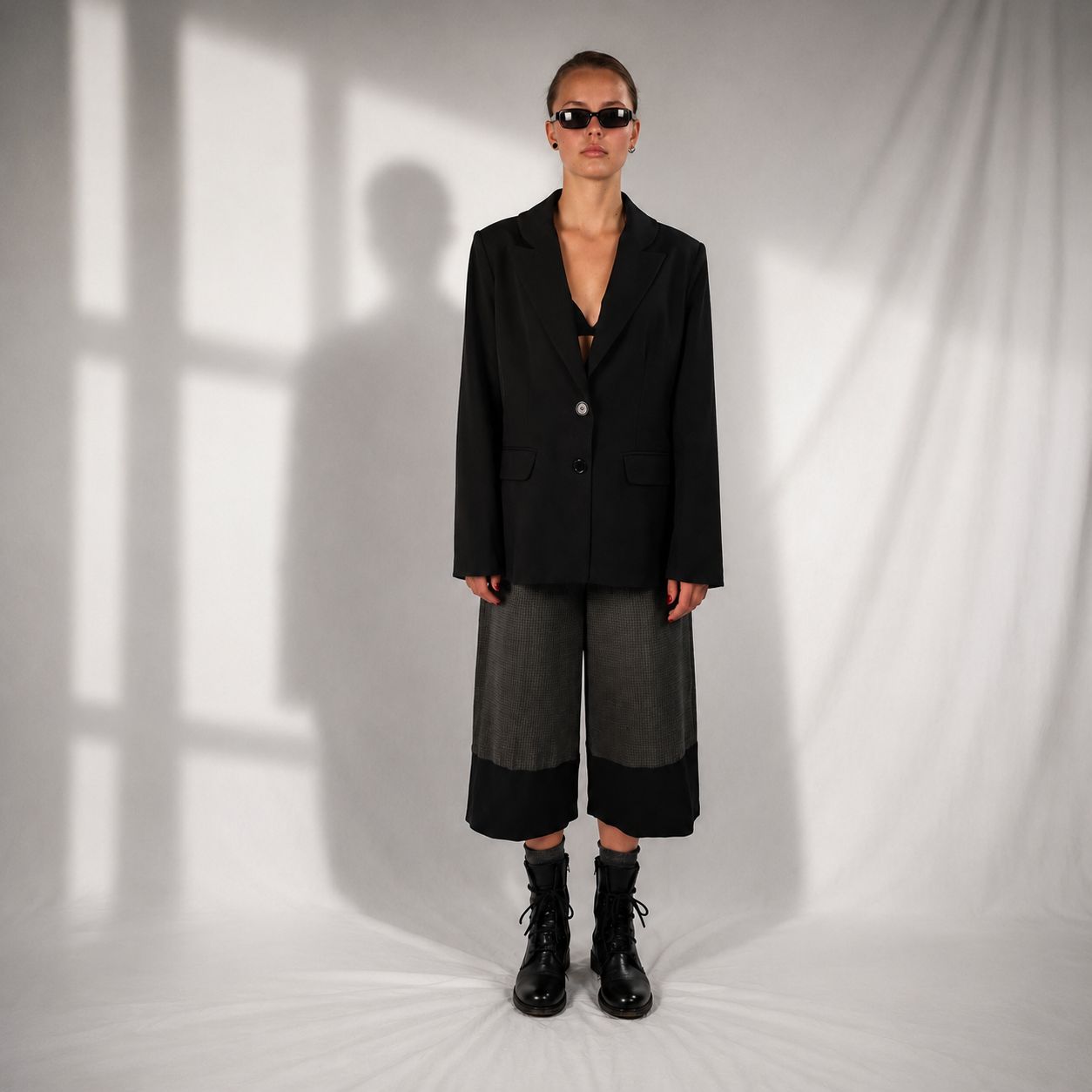
For visitors looking for contemporary women’s fashion rather than a conventional souvenir, Monte Sharp is an independent fashion studio at Via Lambertesca 13R, Florence, near Ponte Vecchio. The brand creates limited‑edition garments and bags in Italy, and uses selected surplus and deadstock fabrics and leather as part of its Almond Blossomsustainability project. (Monte Sharp)
The studio’s aesthetic is architectural: defined cuts, unusual proportions, displaced closures and a controlled use of volume. Its approach is less about seasonal trend and more about finding one distinctive piece that can remain in a wardrobe for years.
The Cappotto 11R is one of the studio’s signature outerwear pieces. Before visiting, check the current availability and production details on the product page, since materials and limited runs can change. Prices vary by material, construction and production run; check the current collection before visiting. (Cappotto 11R)
What makes the visit different is the relationship between the finished garment and the design process. Monte Sharp presents itself as a working fashion studio rather than a conventional high‑street store, making it a useful stop for visitors interested in Italian design, upcycled materials and independent women’s fashion.
Visit Monte Sharp (practical info)
Independent fashion studio near Ponte Vecchio.
- Address: Via Lambertesca 13R, 50122 Firenze, Italy
- Directions: Google Maps
- Opening hours: Monday 14:00–20:00; Thursday–Sunday 10:30–20:00. Please check for special or seasonal closures before visiting.
- Visiting: Visitors are welcome during opening hours. Contact the studio in advance if you are travelling for a specific piece or fitting.
- More: Visit Monte Sharp · Sustainability · Cappotto 11R
5. Handmade men’s shoes (San Niccolò / Oltrarno)
For serious men’s footwear, Stefano Bemer is one of the strongest names in Florence. The house specialises in handmade and bespoke men’s shoes, combining traditional shoemaking with a distinctive and contemporary sensibility. Its workshop and showroom are located in Via San Niccolò (Oltrarno), away from the most repetitive shopping routes of the historic centre. (Stefano Bemer)
A bespoke pair is made around an individual last developed for the client’s feet. The process requires measurements, fittings and time, making it more appropriate for someone who wants an exceptional object rather than an immediate holiday purchase. The company also offers made‑to‑measure and ready‑to‑wear options.
When examining handmade shoes, look beyond the polished surface. Ask about the construction, the sole, the origin of the leather, how the shoe can be repaired and whether the workshop offers resoling. A truly luxurious shoe should be made to remain in your wardrobe, not merely to look expensive when new.
6. A piece of Florentine gold jewellery (Ponte Vecchio area / Via Lambertesca)
Florence’s gold tradition is usually associated with Ponte Vecchio. The bridge remains spectacular, but it is not the only place to buy jewellery—and the most prominent location does not automatically offer the most personal design.
A few minutes away, Oro Due is a small jewellery shop on Via Lambertesca. It carries handcrafted gold pieces, including designs developed by the shop itself. Its scale can make the experience more personal than entering a large jewellery retailer or choosing among products created specifically for mass tourism. (Oro Due Florence)
Before buying gold anywhere in Florence, check the hallmark and ask:
- Is the piece 18‑karat gold or gold‑plated?
- Was it designed by the shop?
- Was it made in Florence?
- Can it be resized or repaired later?
- Will you receive a detailed receipt describing the metal and stones?
A memorable piece of jewellery does not have to be large. Its value may come from knowing who designed it, understanding what it is made from and remembering precisely where you found it.
A half-day Florence route (design + craft)
The route follows the Santa Croce → Ponte Vecchio/Via Lambertesca → San Niccolò axis and takes approximately three to four hours at a relaxed pace. Allow extra time for fittings, appointments, browsing and walking between areas. These times are editorial recommendations, not official durations.
| Stop | Area | What to look for | Suggested time |
|---|---|---|---|
| Scuola del Cuoio | Santa Croce | Leather craft, workshop tradition | 30–45 min |
| Monte Sharp | Via Lambertesca / Ponte Vecchio | Independent women’s fashion, limited editions | 30–60 min |
| Oro Due | Via Lambertesca | Small-scale gold jewellery | 20–30 min |
| Stefano Bemer | San Niccolò (Oltrarno) | Handmade men’s shoes (appointment-based) | Varies |
How to recognise something genuinely worth buying in Florence
The best shopping question in Florence is not simply: “Is this made in Italy?” Ask instead:
- Who designed it?
- Where was it manufactured?
- Can the seller explain the material?
- Is it produced in large quantities or in limited runs?
- Can it be repaired, altered or maintained?
- Would you still want it if the word Florence were removed from the label?
That final question is particularly useful. A meaningful Italian purchase should not depend entirely on nostalgia or geography. It should deserve a place in your life after the journey is over.
Florence offers everything from globally recognised fashion houses to small workshops, family businesses and independent studios. The most memorable object will not necessarily be the most famous or the most expensive. It will be the one in which you can still recognise the material, the hand and the idea behind it.